All photos © Robin and Arlene Karpan
If we had to pick our favourite part of landscape photography, it would be capturing the rising full moon as part of the landscape. It’s one of nature’s great spectacles that occurs every month, and occasionally twice a month in the case of a Blue Moon. Best of all, we can control how big the moon appears in the frame, from a tiny dot to a massive orange ball dominating the scene.
The actual size of the moon doesn’t change, but we can decide on how big the moon appears in relation to the rest of the photo. We’re not talking about cloning a photo of a large moon and inserting it into another photo – something that usually looks fake. Rather, we can adjust the apparent size of the moon and get it all in one shot without any artificial sleight of hand.
What is a “normal” moon?
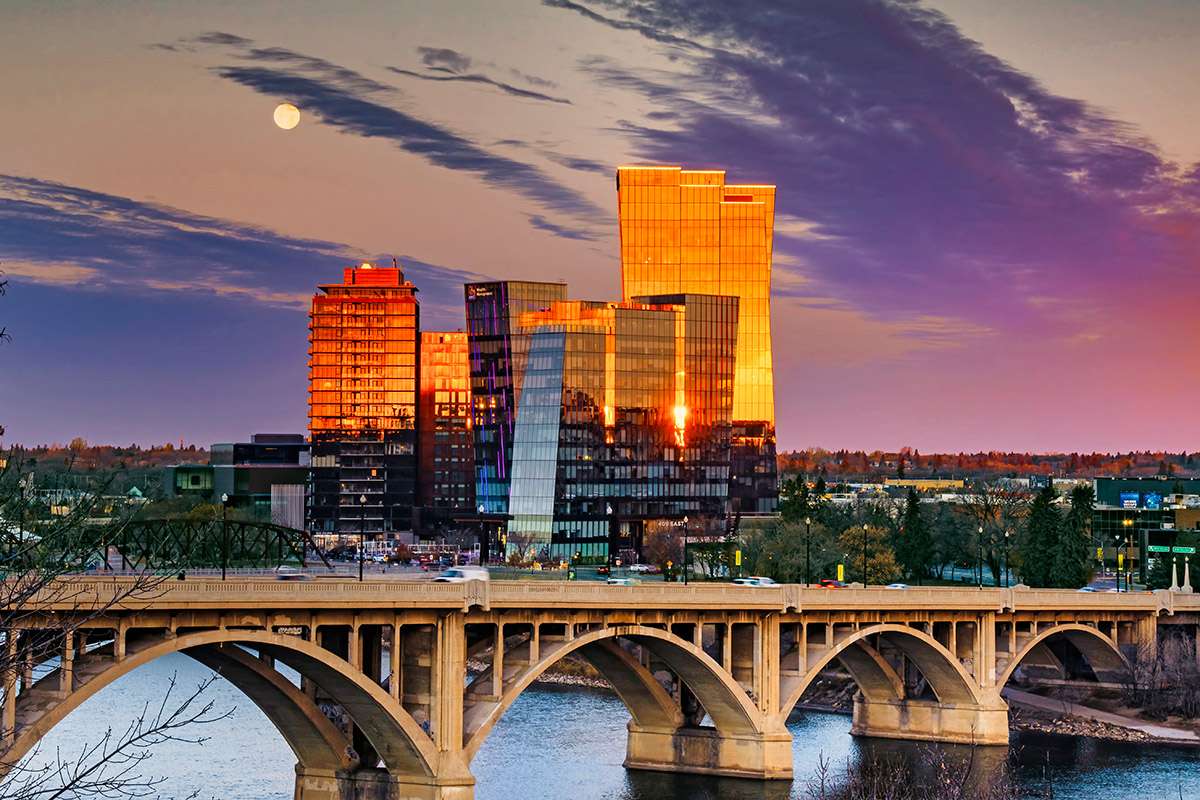
In our “normal” field of view, the moon isn’t very large. If you stretch out your arm, you can easily cover a full moon with your thumb. A normal field of view is generally considered to be equivalent to looking through a camera with a lens at about a 50mm focal length. Sometimes lenses close to this focal length are even referred to as normal or standard lenses. For the following photo of the Saskatoon riverbank, we used a focal length of 55mm. This is very close to the view we would get by simply looking at the scene with our eyes rather than through the camera.
Adjusting the size of the moon
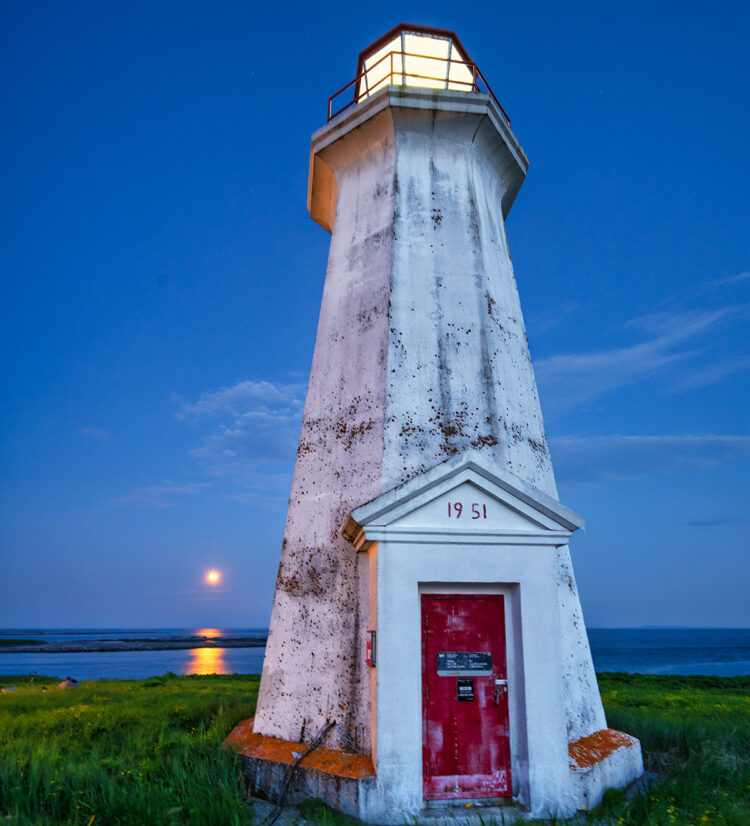
How big the moon appears in the frame depends on the focal length of the lens and how far away you are from your foreground subject. On one extreme, the following image is taken with a 16mm lens. We were staying on a tiny island in Quebec’s Mingan Archipelago National Park during full moon. Because it wasn’t possible to go back any farther without falling off the edge of the cliff, it was necessary to use a wide angle lens to get the entire lighthouse in the frame as well as the moon. Consequently, the moon looks miniscule.
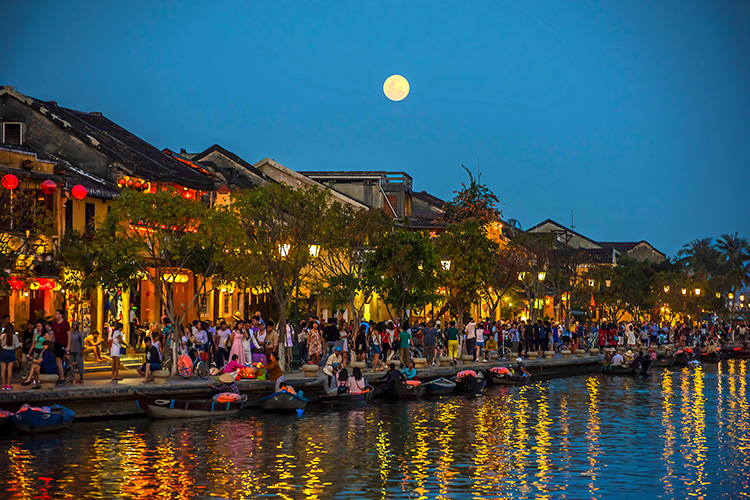
The next image, from Hoi An, Vietnam, had a focal length of 135mm. Compared to the previous photos, the moon occupies more of the frame and appears to be bigger.
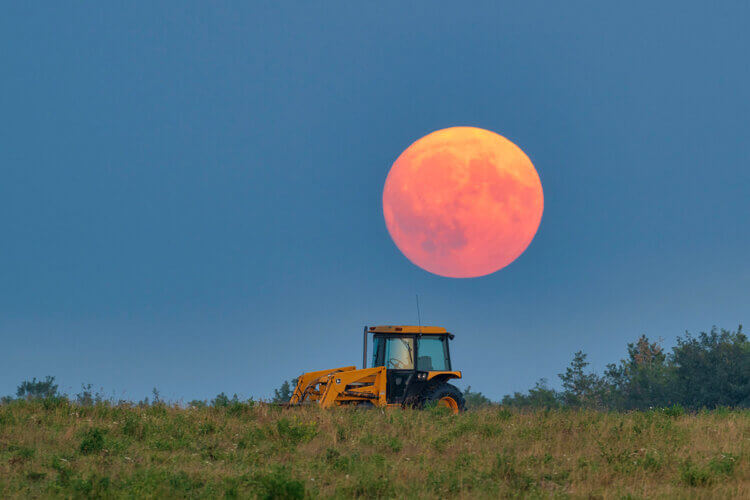
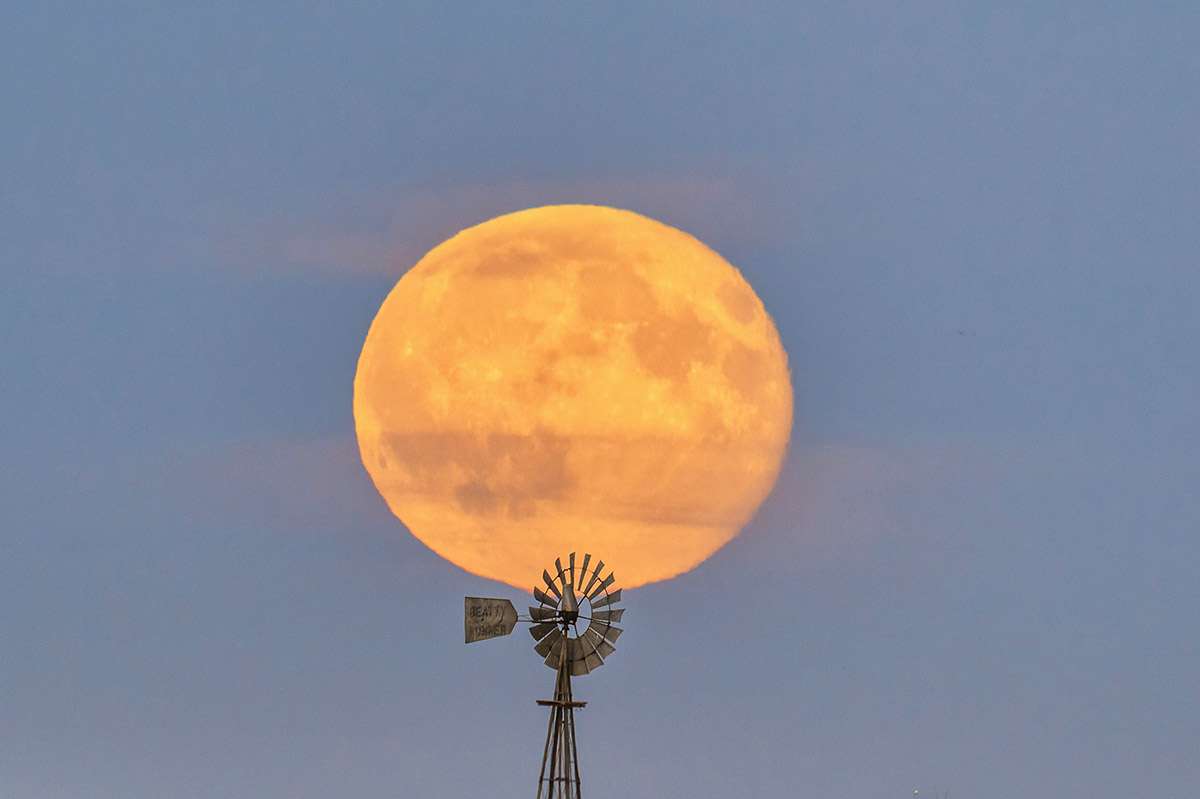
The next image goes a huge step farther by using a 600mm lens, making the moon appear enormous.
Distance from your subject matters as well
But the focal length is only one factor. In the above photo, it’s also that we positioned the camera quite far from the windmill, just over a kilometre away. The farther we are away from the main subject in the frame (in this case the windmill) the larger the moon will appear.
On the following two photos, note the size of the moon in relationship to the elevator. The first photo is taken from around 1 km away while the second is from a bit over 3 km. The farther away from the subject, the larger the apparent size of the moon.
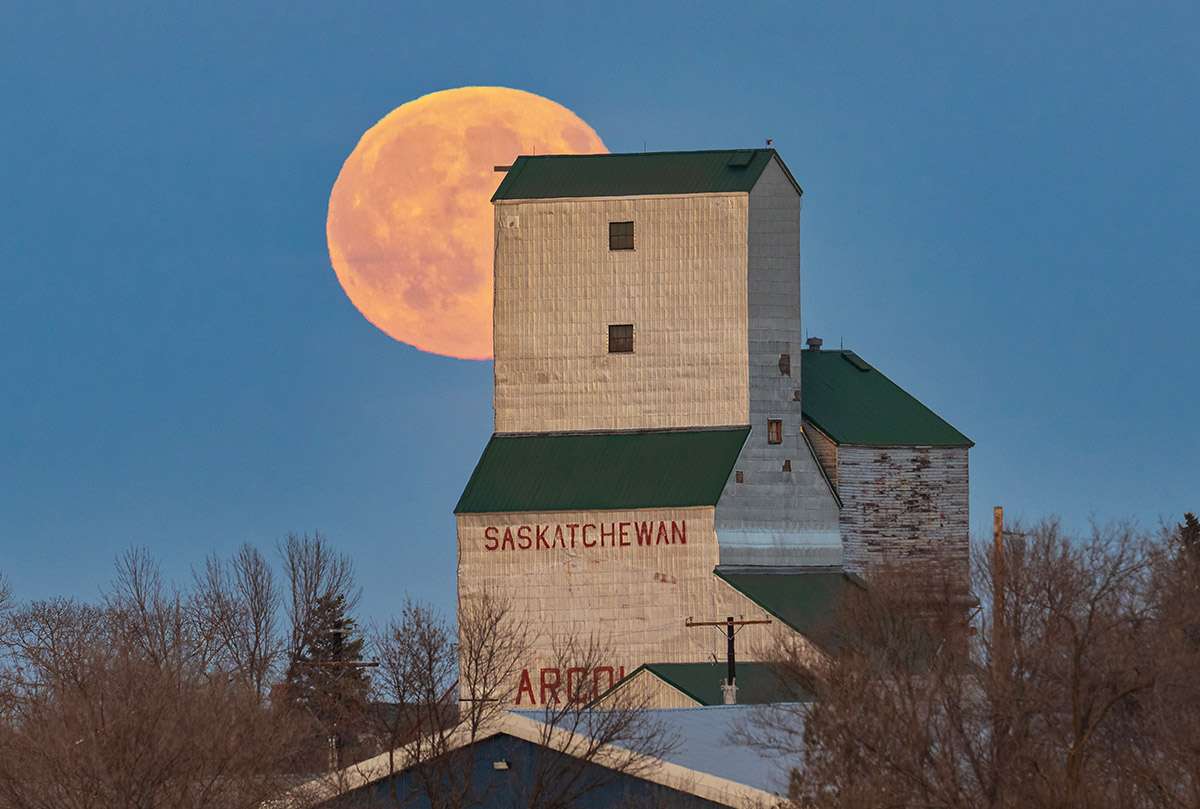
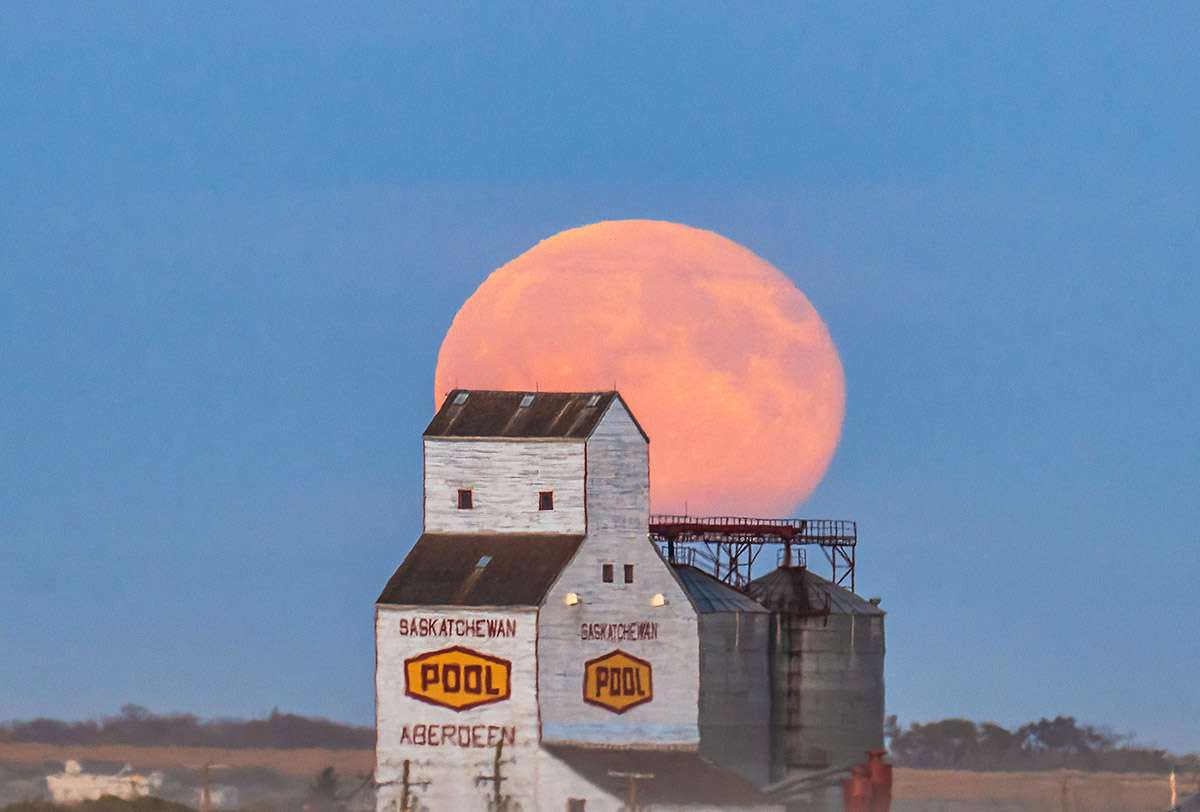
While photographing from farther away results in a bigger moon, there may be trade-offs. Distortions caused by atmospheric conditions become more pronounced with more space between your camera and subject. In the second photo above, it was a still evening and dust from a gravel road hung in the air. We can see distortions on the print on the elevator.
Where to focus?
The biggest challenge in photographing a scene with a big moon is getting both your subject and the moon in focus. Your foreground subject may be a kilometre or so away, but the moon is over 300,000 km away. Part of the challenge is that the longer the focal length of your lens, the shallower depth of field it will have. Long telephoto lenses are more commonly used for things such as wildlife photography where a shallow depth of field is often what we want. When we take a photo of a bird sitting on branch, for example, we often want the background to go blurry, helping the bird stand out better. But this isn’t what we want here.
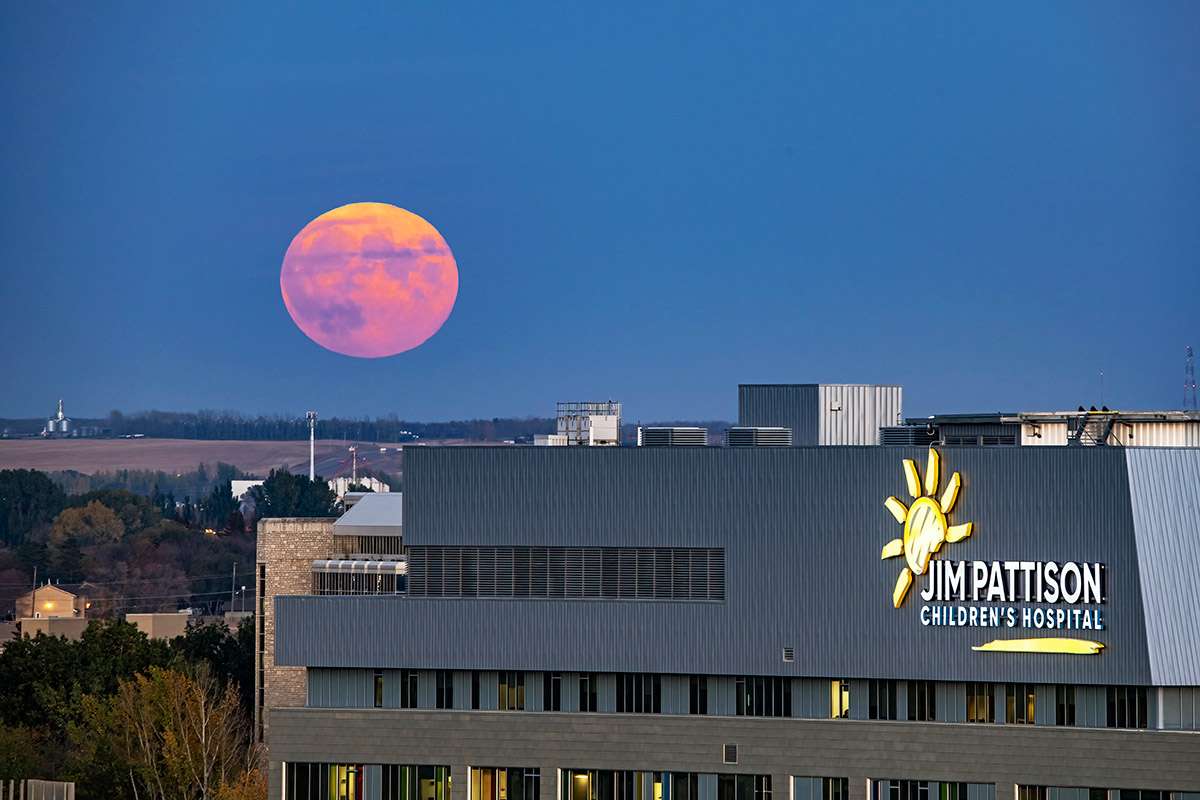
While we night strive for getting both in focus, there is nothing wrong with having your subject in focus and the moon in the background slightly out of focus. Sometimes we may even want to purposely put the moon out of focus, just for variety. When it is difficult to get both in focus, we always give priority to focusing on the subject, making sure that it is as sharp as possible.
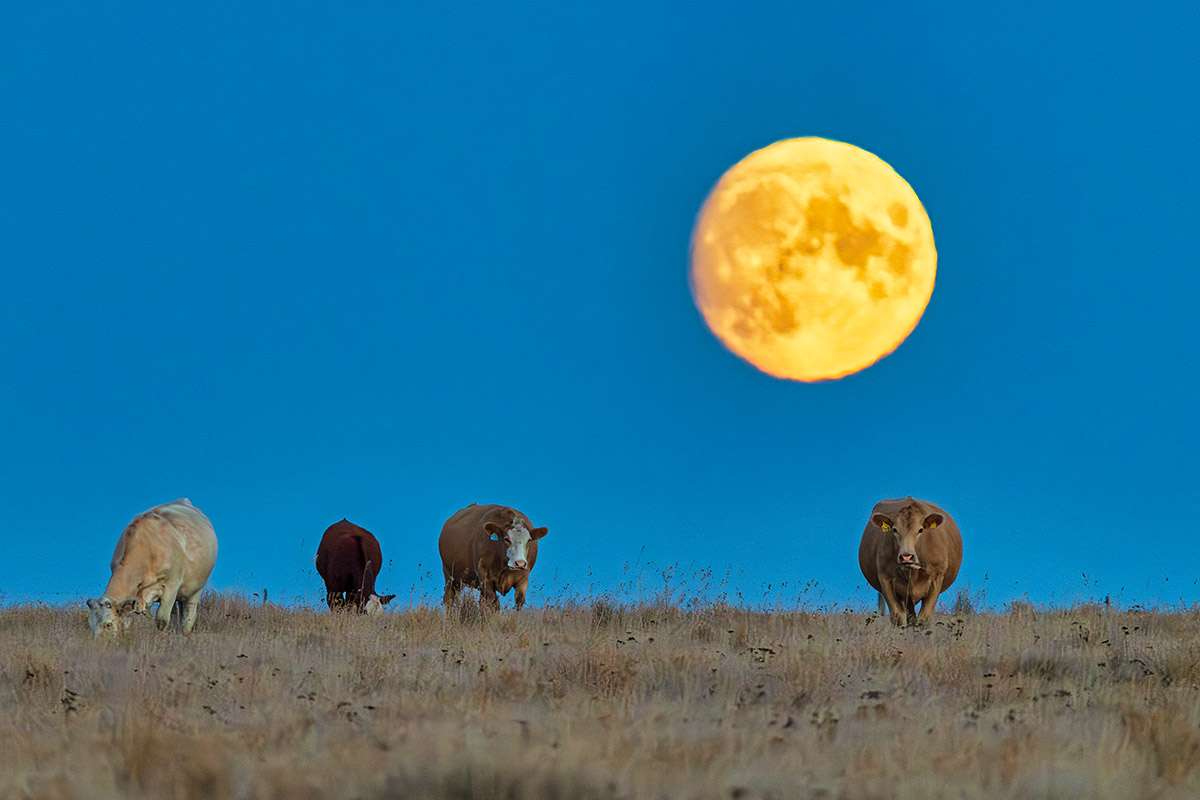
For the following photo, it was dark, and the cows were constantly moving, so it was necessary to use a fast enough shutter speed to keep the cows from blurring and an extremely high ISO because of the dark. Unlike the other shots that were planned in advance, this was a spur of the moment idea when I noticed the moon over the cows, so I concentrated on getting the cows as sharp as possible. Even though the moon is not sharp, I think that the photo still works. On the other hand, if I had focused on the moon and the cows were blurry, the image would just look weird.
Getting both your subject and moon in focus
To get both your subject and the moon in focus, it’s useful to determine the hyperfocal distance of the camera and lens combination. This is the focusing distance that maximizes the depth of field from front to back. But most critical here, it’s the nearest distance you can focus the lens to get acceptable focus at infinity (which includes the moon, sky, and far away landforms).
There are hyperfocal charts you can look up, but the easiest way we have found to get this information is to use the PhotoPills app which is extremely useful in helping to plan all aspects of moon, sun, and night sky photos. Enter the make of camera and the focal length of the lens and it will give you the hyperfocal distance for a full range of different aperture settings.
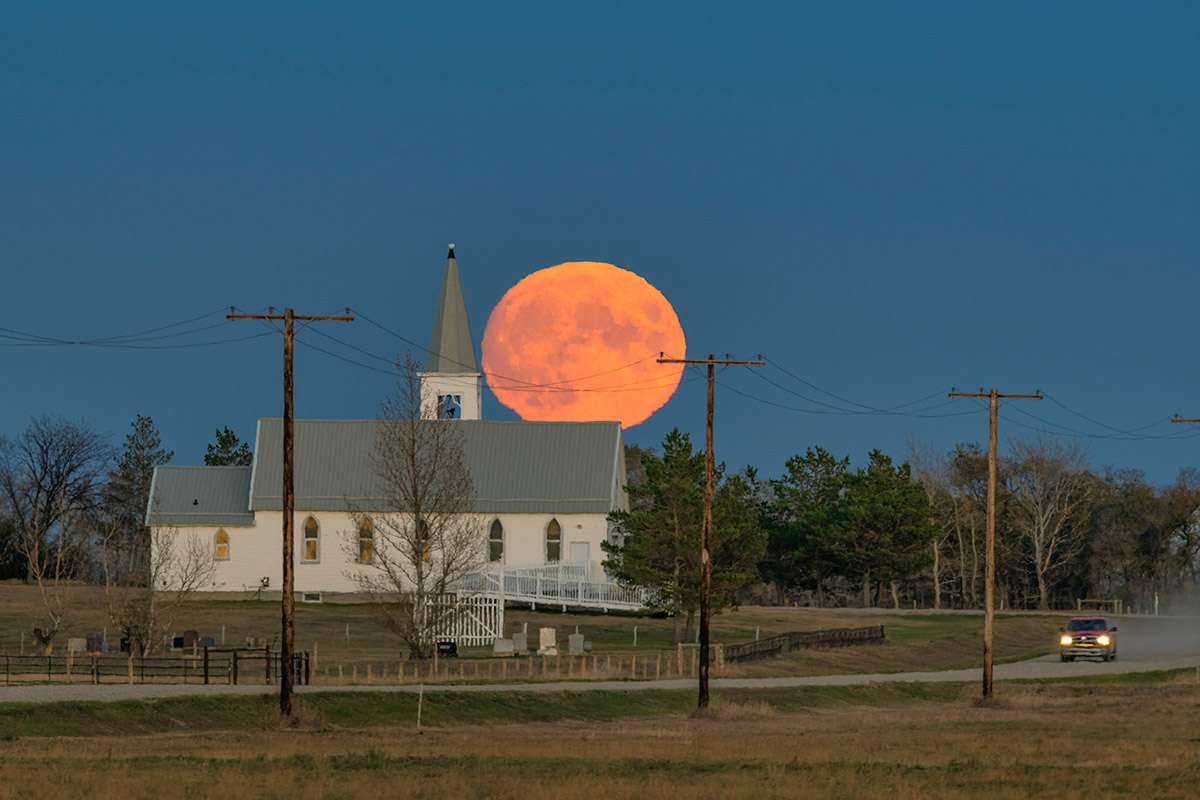
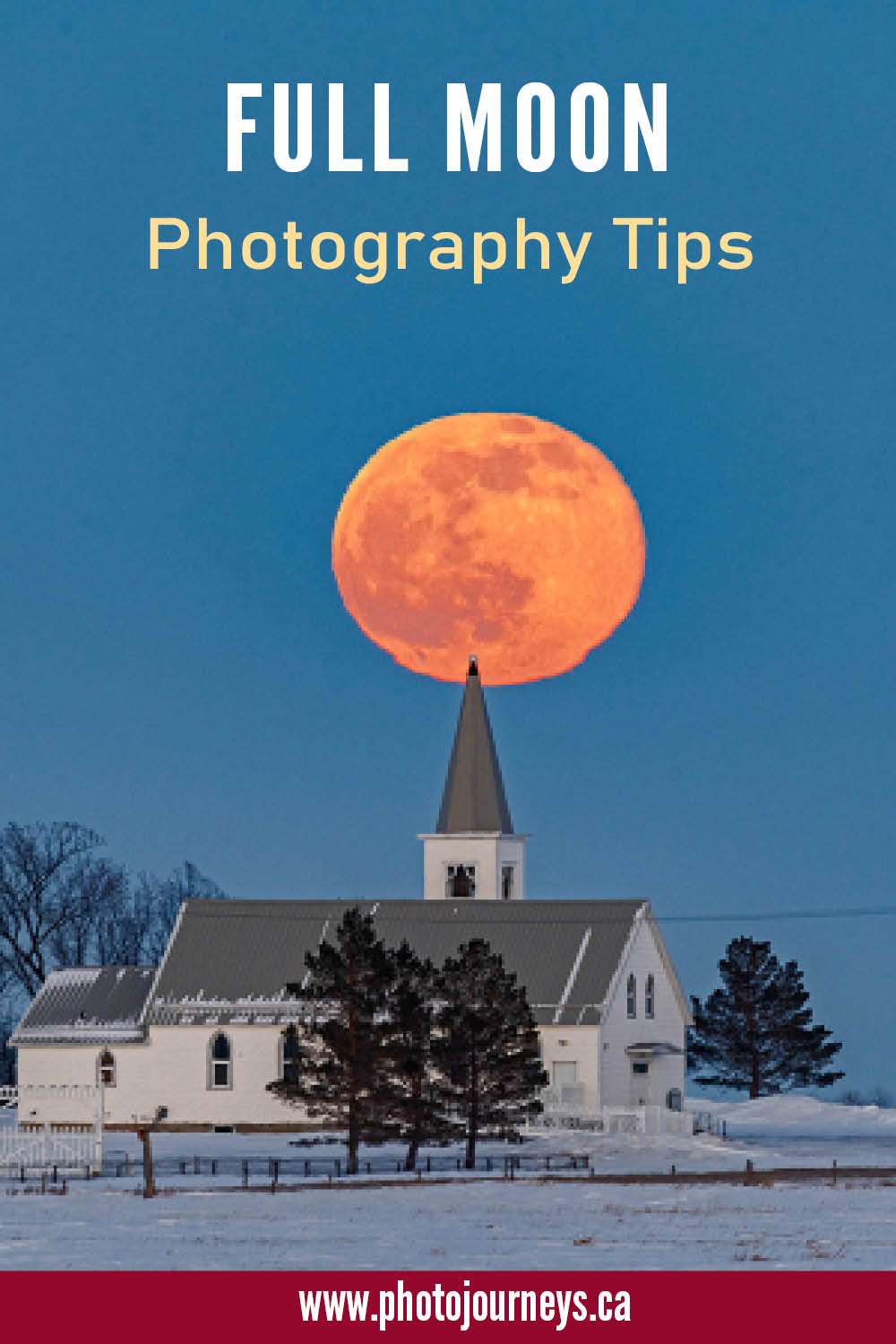
The reason why this is important is that in order to get both the subject (such as a church steeple) and moon in focus, the hyperfocal distance cannot be farther away than your subject. Otherwise, if you focus on the church, the moon will be out of focus.
This is less of an issue with wide-angle lenses, where the hyperfocal distance might only be a few metres in front of the camera, but with long telephotos the distance is much farther. To take an extreme example, on our 600mm f/4 lens, shooting wide open at f/4 has a hyperfocal distance of just over 3 kilometres! But photographing from that far away is difficult and often impossible, so we need to determine what is feasible.
Distance matters as well
Hyperfocal distance is dependent not only on the focal length of the lens but also the aperture setting. A smaller aperture opening such as f/11 or f/16 brings the hyperfocal distance closer to the camera while a larger aperture opening such as f/2.8 or f/4 takes it farther away.
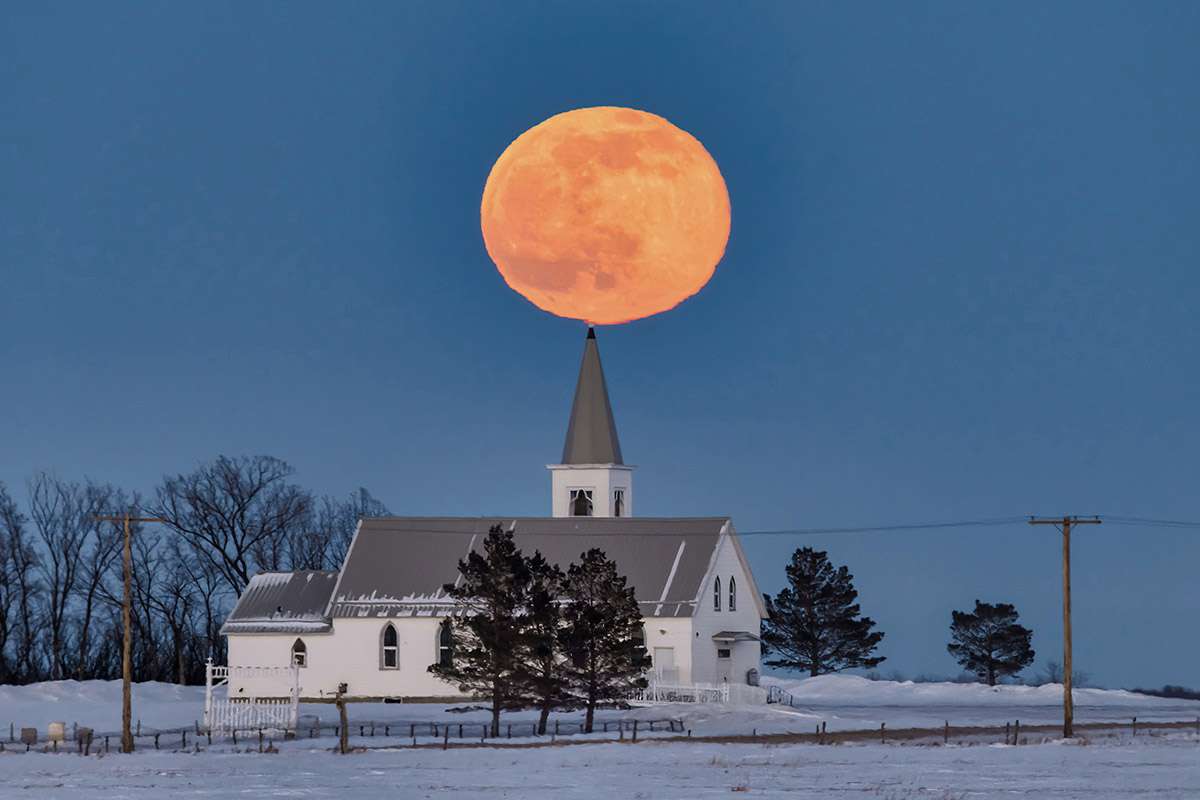
Using the example of the Pleasant Point Church above, we looked up on the PhotoPills app where we would have to set up the camera in order to see the full moon rise over the church. We discovered that we could photograph from the roadside about 1.1 kilometres away from the church (the app does the distance calculations).
We wanted to get a huge moon in the photo, so decided to use the 600 lens. However, we could only get acceptable sharpness for both the church and moon if the hyperfocal distance is less than 1.1 kilometres. The app showed that an aperture setting of f/11 had a hyperfocal distance of about over one kilometre, which is why we used that setting.
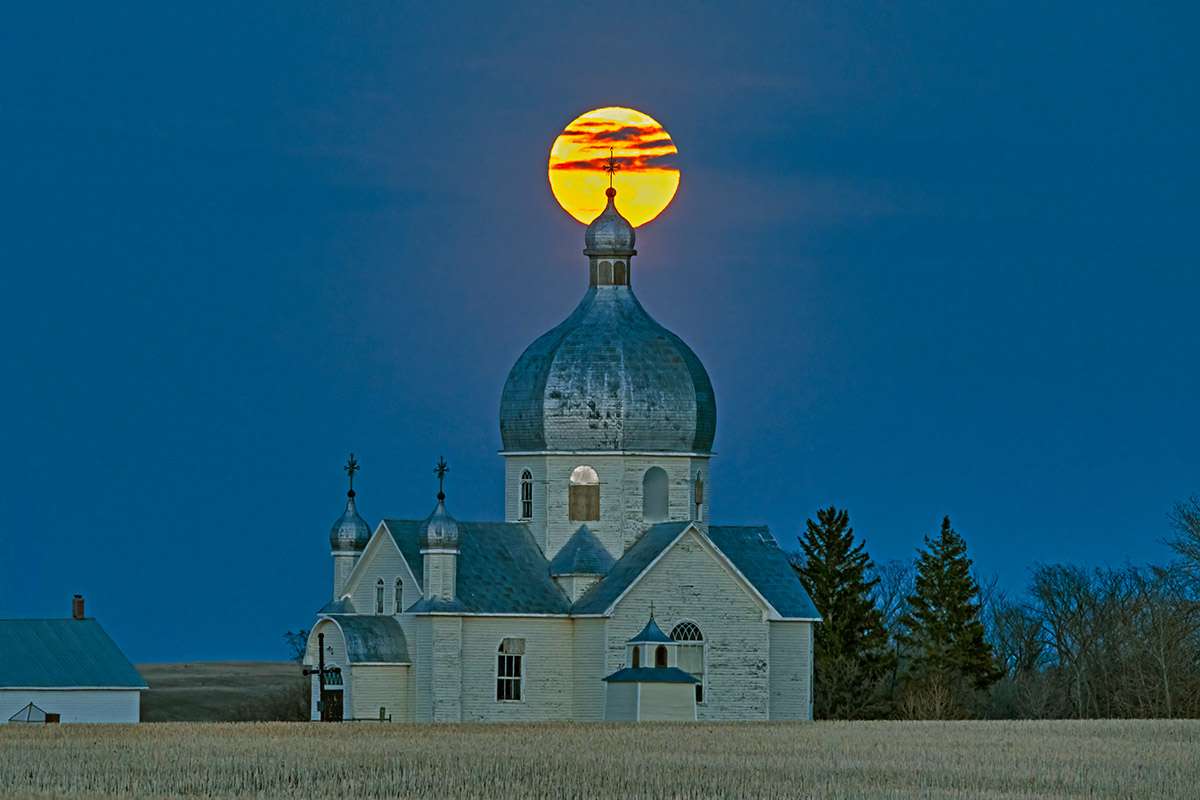
The other option is to use a lens with a shorter focal length. For the following photo, the farthest we could be away from the church was less than 500 metres because of road access and where we could get an unobstructed view. This would be too close for a 600mm lens to work to get both the church and moon in focus. So we opted for a zoom lens extended to 370mm. At f/11, the hyperfocal distance was a bit closer than the distance to the church. So by focusing on the church we were able to get acceptable sharpness on the moon as well.
When is the best time to photograph the full moon rise?
This might seem like a dumb question at first. Don’t we simply pick the day when the moon is full? This is easy to look up and even most wall calendars indicate full moon days. But it’s not always that straightforward. While the full moon technically occurs on a specific day, for photography the moon is sufficiently full on the day before and the day after that. There is little noticeable difference. Occasionally, one of those days might be preferable.
It’s important to look at what the sun is doing at the same time. Usually, sunset and moonrise are at much the same time during the full moon, but this varies throughout the year. For example, lets look at the full moon for December, 2025, which officially falls on the 4th. The full moon that day rises at 4:07 pm, but the sun doesn’t set until 4:56 pm. So the sun is still quite high when the moon starts clearing the horizon. The moon would look faint and washed out at that time, if we can even see it all.
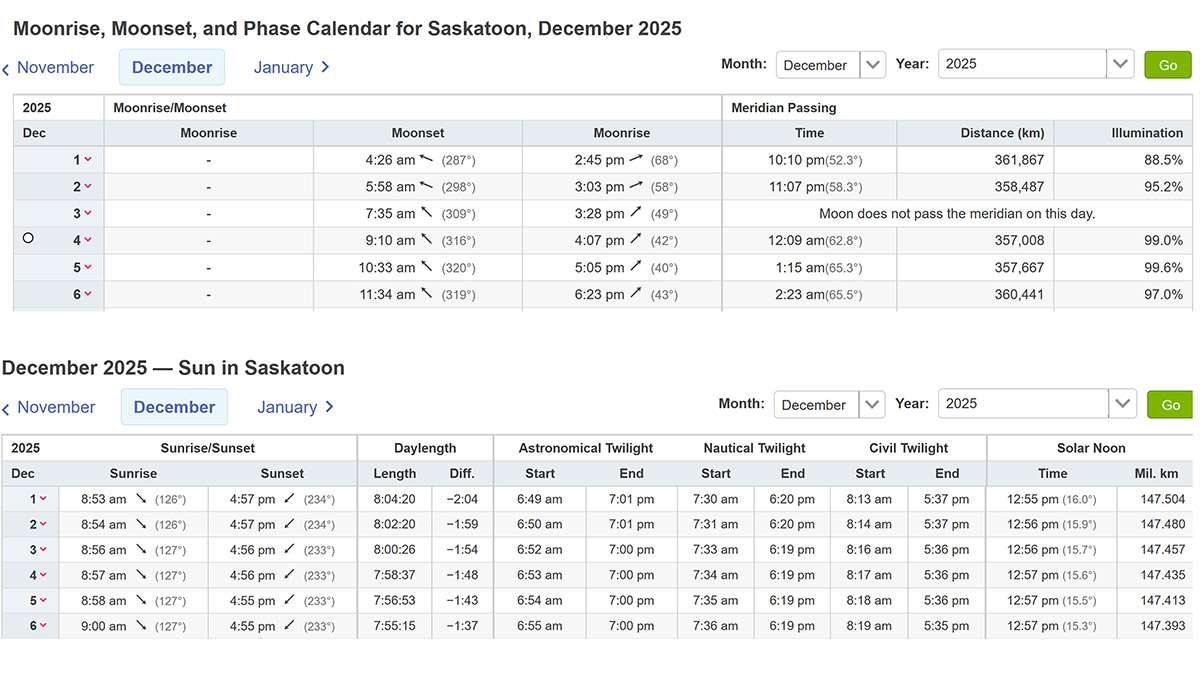
The following day, Dec. 5, is a lot better. The moon rises at 5:05 pm, 10 minutes after sunset. With the sun out of the way, it will be sufficiently dark that the moon will have a rich orange glow. Because it is just after sunset, there will be enough ambient light that we can still see sufficient detail in our foreground subject (church steeple, grain elevator, or whatever). This is ideal timing.
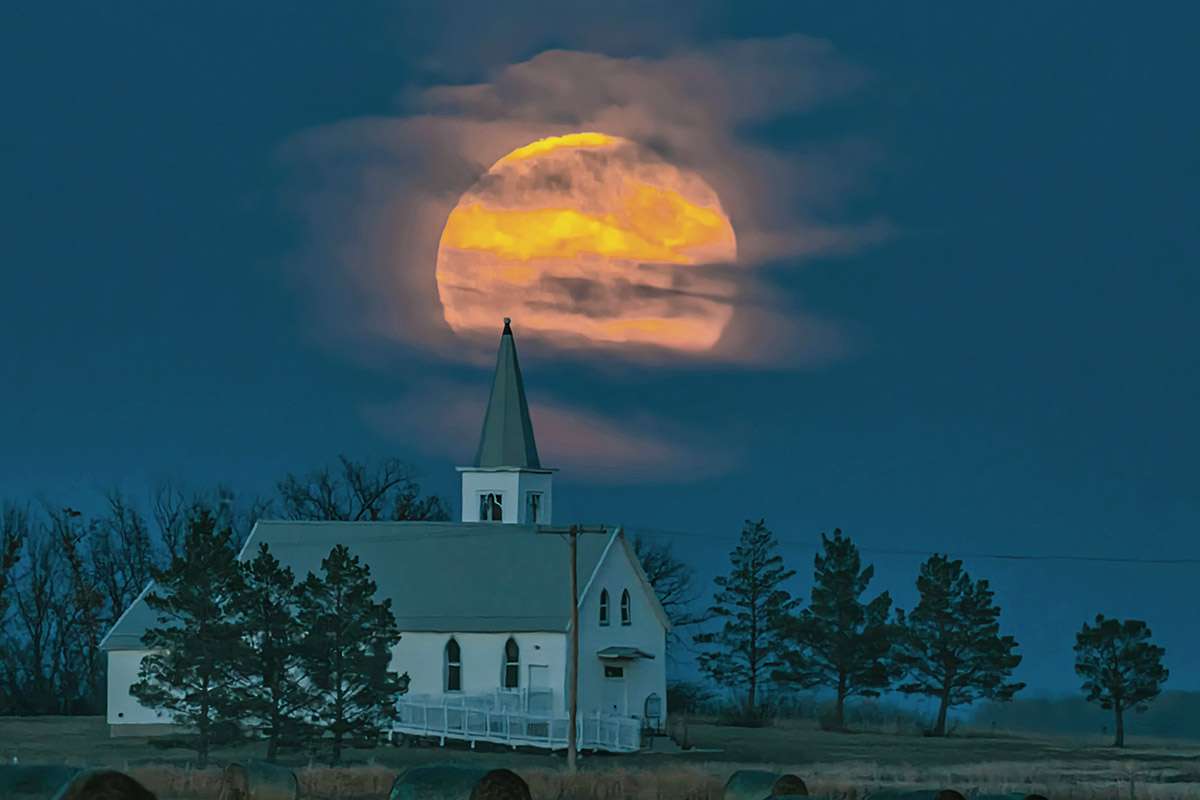
On days when the moon rises too long after sunset, you can still get a nice orange moon, but your foreground subject might be too dark to show much detail.
Final thoughts
Shooting the moon can be a lot of fun. With a bit of planning, we can decide exactly where it will be in the frame and how big it looks. It’s the perfect opportunity to play around with different foreground subjects and different focal lengths to get dramatically different results.
SUBSCRIBE to Photojourneys below
Feel free to PIN this article on how to photograph the full moon